PåNĐA: time Petri Nets Diagnosability Analyzer
PaNDA is a formal verification tool for the state estimation, prognosis and diagnosability of time Petri nets (TPN).
Downloads
Release 0.3 (July 2025), see the Download page.
| panda_Darwin_arm64.tar.gz | For macOS 13 (Ventura) or later, on Apple Silicon |
| panda_Darwin_x86_64.tar.gz | For 64-bit macOS 10.14 (Mojave) or later, on Intel Macs |
| panda_Linux_arm64.tar.gz | For 64-bit Linux, ARM aarch64 executable, statically linked |
| panda_Linux_x86_64.tar.gz | For 64-bit Linux, x86-64 executable, statically linked |
| panda_Windows_arm64.zip | For 64 bit Windows PE32+ executable (console) on Aarch64 |
| panda_Windows_x86_64.zip | For 64 bit Windows, PE32+ executable (console) on x86-64 |
Usage
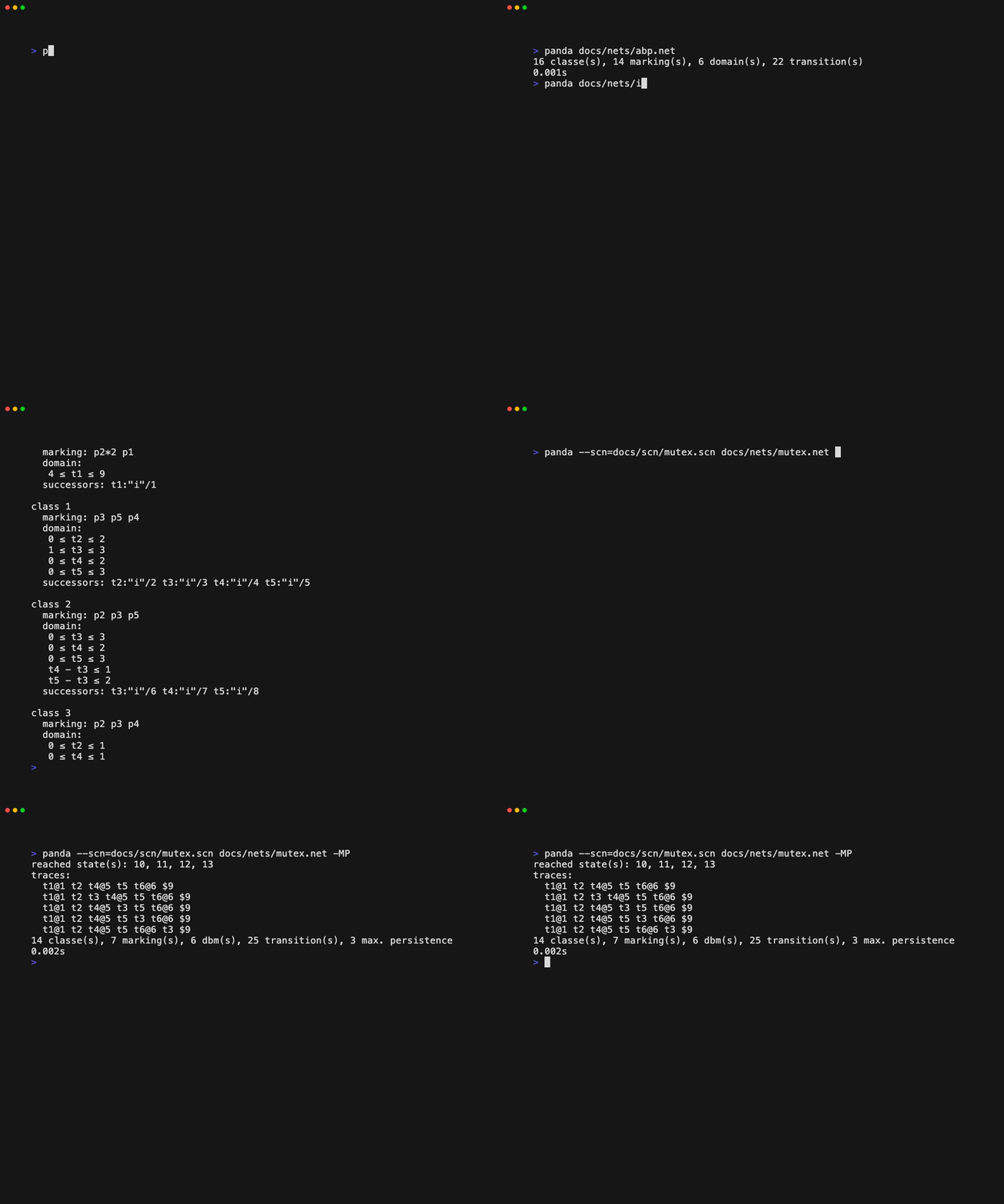
By default, panda builds the strong State Class Graph (SCG) of a Time Petri net, according to the technique implemented in the tool Tina (with option -S). The SSCG is an abstraction of the state space of the net that preserves reachable markings and traces, meaning the set of (untimed) execution sequences.
panda [flags] file
Panda takes a file, in the .net textual format used by Tina, and prints its result on the standard output. We read the content of the file from the standard input when using the special file name -. Panda can handle Petri nets with read and inhibitor arcs but does not support priorities yet.
The basic flags are:
-h, --help
    Print usage information.

--version
    Print version number and generation date.

-q, --quiet
    Block the display of statistics information.

-v, --verbose int[=1]
    Textual output (use -v=2 for more info) (default none).
Build flags, to select the SCG construction:
-S, --strong
    Generate the strong SCG, preserving states and LTL (default).

-W, --linear
    Linear SCG, preserving LTL.

-M, --mscg
    Modified SCG.

-R, --rmscg
    Reduced version of the MSCG (prototype).
Stopping test and limit flags (mutually exclusive flags):
-c, --climit int
    Limit on number of explored classes (default none).

-s, --scn string
    Name of scenario file, e.g. --scn=aa.scn. Limit the generation of
    the SCG to the transition sequences matching the scenario.

-d, --date int
    Time horizon for fault prognosis (default none).
Output format and options flags:
-P, --plan
    List traces matching a scenario or a time horizon (only with -M and -R).
    Add option -v to print the associated constraints systems.

--aut int[=1]
   Output LTS in .aut format, as read by Aldebaran. Option --aut=2
   encodes state properties, see the manual pages of tina for option -wp.

--lt
   Output labelled transition properties with --aut.

--serve string[="1313"]
   Display LTS inside a Web page (default https://localhost:1313).
files:
-
infiles: input file is stdin when using -
-
outfile: output is always on stdout
-
errorfile: error are always printed on stderr